A card without your name on it is a good start and a poor finish. Everything else in a checkout flow — the email, the address, the browser, the wallet the money came from — can hand back what the card withheld.
Think in links, not products
Privacy is not a product you buy once. It is a chain, and it is only as strong as the weakest link. A typical online purchase has at least six: the payment instrument, the email, the delivery address, the account you are logged into, the browser, and the network you are on.
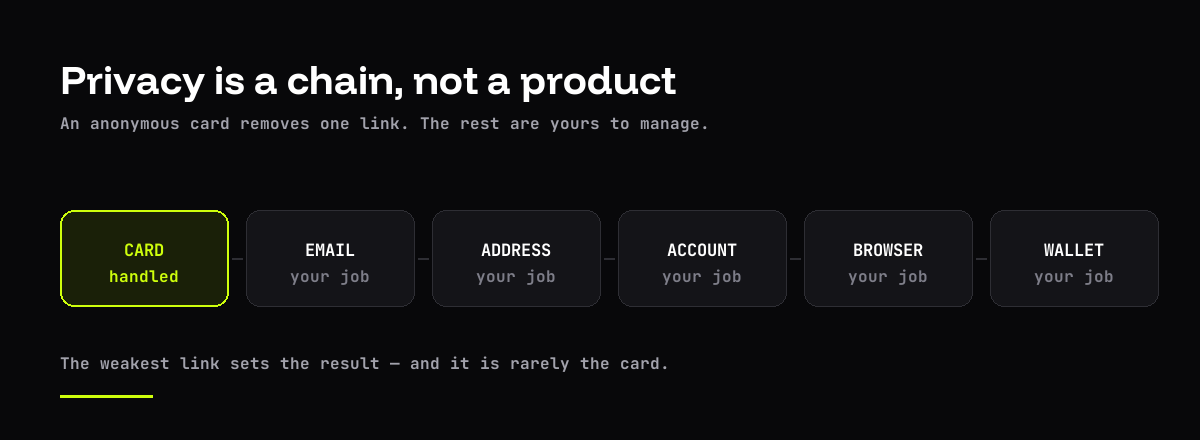
An anonymous card removes one of those six. That is genuinely useful — the payment instrument is the link most often used to tie purchases together into a profile. But a single strong link does not make a strong chain.
Ask the honest question: if someone wanted to connect this purchase to me, which link would they use? It is rarely the card.
Email is the link people underestimate
A reused email address is the single most effective way to connect otherwise separate activity. It is stable, unique and deliberately shared with every merchant.
- Use a separate address for purchases you want kept apart from your main identity. Not a fake one — one you actually control and can still read.
- Avoid addresses containing your real name.
firstname.lastname@defeats the purpose before you have finished typing. - Keep access to it. Card details, receipts and password resets go there.
This matters for ZERO ID specifically: virtual card details are emailed, and we do not verify addresses. A typo sends your card number somewhere you cannot reach.
Delivery addresses, and how to avoid needing one
A physical card has to arrive somewhere, and that somewhere is a real place connected to a real person. This is the least avoidable disclosure in buying a metal card.
The clean answer, if the disclosure bothers you, is not to generate it: a virtual card ships nothing. At $25 it is also the cheapest tier.
Browser and network hygiene
- Use a separate browser profile for private purchases. Not just a private window — a distinct profile, so cookies and logins do not bleed across.
- Do not shop while logged into a big account. Being signed into a major platform in the same profile is an identity beacon.
- Decline non-essential cookies. It takes a click and removes a tracking channel.
- Be realistic about VPNs. A VPN hides your IP from the site and moves that visibility to the VPN provider. That is a trade, not an erasure.
Where the money came from
This is the link most often missed, because it happens before the purchase.
Blockchains are public and permanent. When you fund a card, the transaction from your wallet to the receiving address is visible to anyone, forever. If that wallet was itself funded directly from an exchange account registered in your name, there is a traceable path from your legal identity to the top-up.
None of this is an argument against funding with crypto. It is an argument for understanding that funding privacy is decided in your wallet, before you ever reach the payment page.
At the checkout itself
- Fill in the minimum. Optional fields are optional.
- Decline the account. Guest checkout leaves less behind than a permanent profile.
- Skip “save this card”. Convenience that creates a stored link between you and the instrument.
- Use the card’s balance as a limit. A compromised card can only lose what is on it.
Set the expectation correctly
No card makes you invisible, and anyone selling that is selling something they cannot deliver. What a crypto-funded prepaid card does well is break the default link between your identity and your everyday spending.
It does not place you outside the law, it does not hide what you type into a merchant’s form, and it does not undo a public blockchain record. Treated as one strong link in a chain you are managing deliberately, it does its job well.
New to this? Start with what an anonymous prepaid card actually is — it sets out the honest limits before you spend anything.