Welcome to WordPress. This is your first post. Edit or delete it, then start writing!
Blog
-
Payment privacy habits that actually hold up
A card without your name on it is a good start and a poor finish. Everything else in a checkout flow — the email, the address, the browser, the wallet the money came from — can hand back what the card withheld.
Think in links, not products
Privacy is not a product you buy once. It is a chain, and it is only as strong as the weakest link. A typical online purchase has at least six: the payment instrument, the email, the delivery address, the account you are logged into, the browser, and the network you are on.
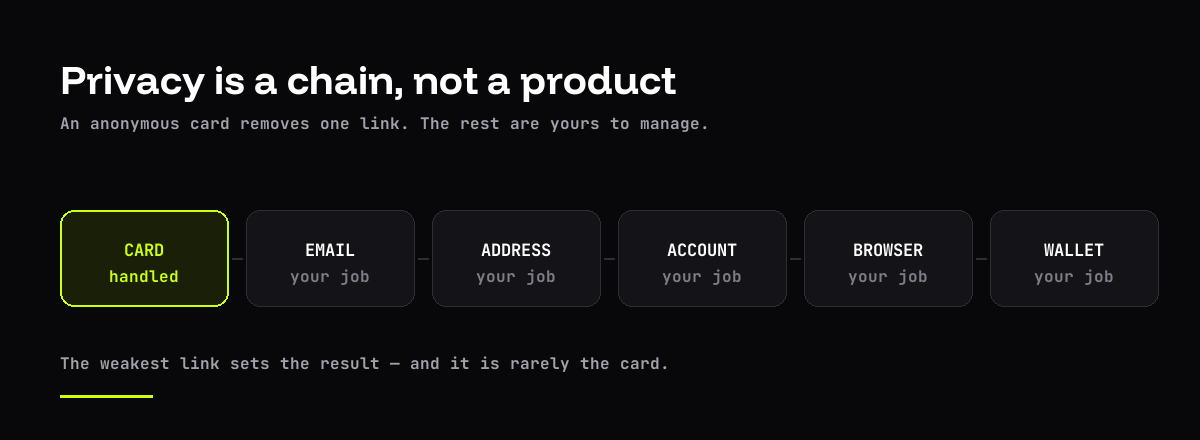
An anonymous card removes one link. The other five are yours to manage. An anonymous card removes one of those six. That is genuinely useful — the payment instrument is the link most often used to tie purchases together into a profile. But a single strong link does not make a strong chain.
Ask the honest question: if someone wanted to connect this purchase to me, which link would they use? It is rarely the card.
Email is the link people underestimate
A reused email address is the single most effective way to connect otherwise separate activity. It is stable, unique and deliberately shared with every merchant.
- Use a separate address for purchases you want kept apart from your main identity. Not a fake one — one you actually control and can still read.
- Avoid addresses containing your real name.
firstname.lastname@defeats the purpose before you have finished typing. - Keep access to it. Card details, receipts and password resets go there.
This matters for ZERO ID specifically: virtual card details are emailed, and we do not verify addresses. A typo sends your card number somewhere you cannot reach.
Delivery addresses, and how to avoid needing one
A physical card has to arrive somewhere, and that somewhere is a real place connected to a real person. This is the least avoidable disclosure in buying a metal card.
The clean answer, if the disclosure bothers you, is not to generate it: a virtual card ships nothing. At $25 it is also the cheapest tier.
Browser and network hygiene
- Use a separate browser profile for private purchases. Not just a private window — a distinct profile, so cookies and logins do not bleed across.
- Do not shop while logged into a big account. Being signed into a major platform in the same profile is an identity beacon.
- Decline non-essential cookies. It takes a click and removes a tracking channel.
- Be realistic about VPNs. A VPN hides your IP from the site and moves that visibility to the VPN provider. That is a trade, not an erasure.
Where the money came from
This is the link most often missed, because it happens before the purchase.
Blockchains are public and permanent. When you fund a card, the transaction from your wallet to the receiving address is visible to anyone, forever. If that wallet was itself funded directly from an exchange account registered in your name, there is a traceable path from your legal identity to the top-up.
None of this is an argument against funding with crypto. It is an argument for understanding that funding privacy is decided in your wallet, before you ever reach the payment page.
At the checkout itself
- Fill in the minimum. Optional fields are optional.
- Decline the account. Guest checkout leaves less behind than a permanent profile.
- Skip “save this card”. Convenience that creates a stored link between you and the instrument.
- Use the card’s balance as a limit. A compromised card can only lose what is on it.
Set the expectation correctly
No card makes you invisible, and anyone selling that is selling something they cannot deliver. What a crypto-funded prepaid card does well is break the default link between your identity and your everyday spending.
It does not place you outside the law, it does not hide what you type into a merchant’s form, and it does not undo a public blockchain record. Treated as one strong link in a chain you are managing deliberately, it does its job well.
New to this? Start with what an anonymous prepaid card actually is — it sets out the honest limits before you spend anything.
-
Funding your card with crypto without losing it
Almost every lost top-up comes down to one of three things: the wrong network, an expired quote, or sending slightly less than the amount shown. All three are avoidable in under a minute of checking.
Crypto transactions are irreversible. There is no chargeback and no support ticket that reverses a send. Check the network and the address before you confirm — not after.
The four options, and what each one costs you
A ZERO ID top-up can be paid in USDT, Bitcoin, Ethereum or USDC. They are not equivalent choices — they differ in fee, speed and how much the amount can move while you are paying.
Coin Network Typical fee Price moves? USDT TRC20 (Tron) Low No — dollar-pegged USDC ERC20 (Ethereum) Higher — Ethereum gas No — dollar-pegged ETH ERC20 (Ethereum) Higher — Ethereum gas Yes BTC Bitcoin Varies with congestion Yes If you have no strong preference, use USDT on TRC20. It is dollar-pegged, so the amount you owe does not drift while you are confirming, and the network fee is small. That combination is why it is the default on the payment page.
The expensive mistake: wrong network
This is the one worth understanding properly, because it is unrecoverable.
USDT exists on several blockchains. The same ticker, the same name, entirely different networks. The ZERO ID receiving address for USDT is a Tron (TRC20) address — it begins with
T. If your wallet is set to send USDT on Ethereum or BNB Chain instead, it will ask for an address starting with0x.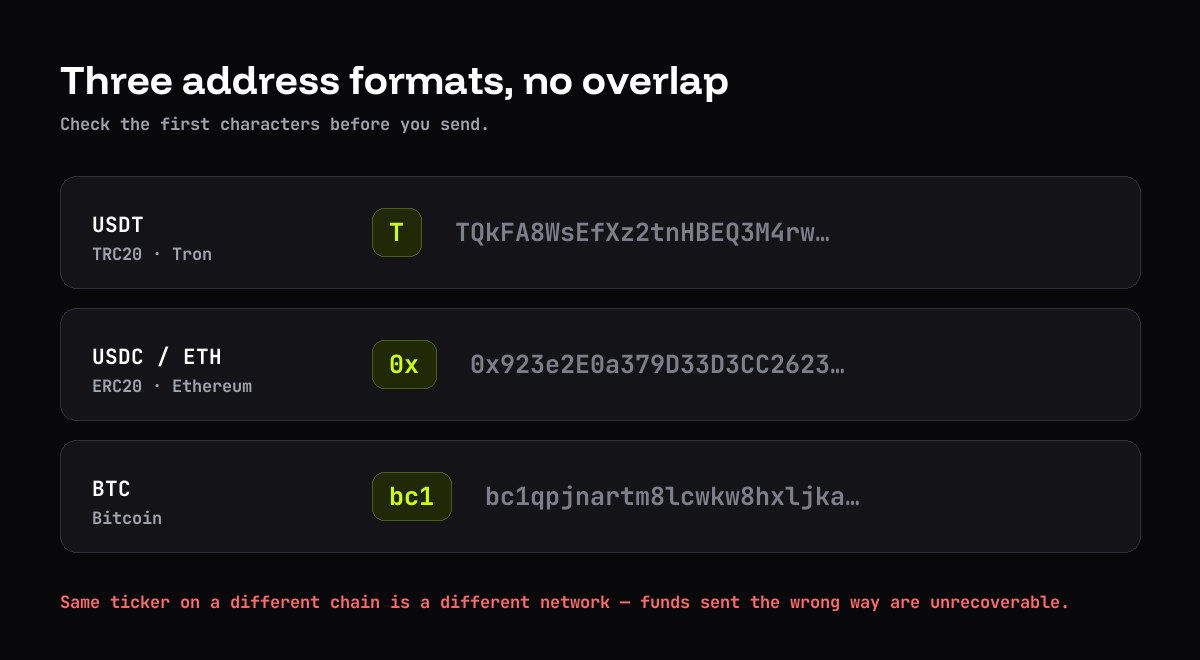
Three formats, no overlap — the first characters tell you which chain you are on. Before confirming, read the network selector in your own wallet — not just the address. Matching addresses is not enough if the network dropdown is wrong.
Topping up, step by step
- Pick your coin first, on the payment screen, before entering the amount. Switching afterwards regenerates the address.
- Enter the top-up amount. The first load has a minimum — $100 on Virtual and Core, $300 on Prime, $1,000 on Black.
- Generate the payment. You will get an address, a QR code, the exact amount in your chosen coin, and a countdown.
- Copy the address with the copy button, not by hand.
- Check the network in your wallet matches the one on screen.
- Send the exact amount shown, then confirm on the page.
Why “exact amount” means exact
Under-payments cannot be credited automatically. The two usual causes:
- Fee deducted from the send. Some wallets subtract the network fee from the amount you typed rather than adding it on top.
- Rounding. Trimming
0.002500 BTCto0.0025is fine; trimming it to0.002is a 20% shortfall.
Sending slightly more is harmless. Sending slightly less creates a manual problem.
The countdown, and what to do when it runs out
The payment screen holds the quote for a fixed window. For USDT and USDC that is mostly a formality. For BTC and ETH it matters: the amount was calculated at a rate captured when you generated the payment.
If the timer expires before you send, go back and generate a fresh payment. Do not send against an expired quote and hope.
A note on privacy when funding
The card itself carries no identity, but the top-up is a public blockchain record. If you send from an exchange account registered in your name, that record links your identity to the receiving address permanently.
If funding privacy matters to you, that is a wallet decision made before you reach the payment page. The privacy habits guide covers the wider picture.
Thirty-second checklist
- Coin on the page matches coin in the wallet.
- Network on the page matches the network dropdown in the wallet.
- Address pasted, never typed — and the first and last four characters match.
- Amount is the exact figure shown, fee added on top.
- Countdown still running.
-
What an anonymous prepaid card actually is
“Anonymous” is used loosely across this industry, and the gap between what people assume and what is true is where disappointment lives. This is the honest version: what a crypto-funded prepaid card hides, what it cannot hide, and why that distinction matters more than any feature list.
The short definition
A prepaid card holds a balance you load in advance. It is not a credit line and not a bank account — there is no overdraft, no interest and no statement cycle. When the balance is spent, the card stops working until you top it up again.
What makes a prepaid card anonymous is not the plastic or the metal. It is the absence of an identity file behind it. A conventional card is issued against a verified identity: your legal name, address, date of birth and a government document sit in the issuer’s records, and every transaction is attached to that file. An anonymous prepaid card is issued without that step, so there is no identity record to attach spending to.
What is genuinely private
- Your name is not on the transaction. Merchants receive an authorisation from the card network, not a dossier.
- Your spending is not aggregated into a personal profile. The thing most people object to is not one purchase being visible — it is every purchase being collected, linked and sold. Without an identity anchor, that aggregation has nothing to anchor to.
- Funding does not route through your bank. Loading with crypto means no bank transfer sits between you and the card.
What is not private, no matter what you buy
This is the part most pages skip, and it is the part worth reading twice. A card is one link in a chain. It does nothing about the other links.
A private card used carelessly is less private than an ordinary card used carefully. The card is the easy part.
- The merchant still sees whatever you type in. If you enter your real name, email and shipping address at checkout, the merchant has them. The card did not leak that — you did.
- Physical delivery needs a real address. A metal card has to be posted somewhere. A virtual card avoids this entirely.
- The blockchain is public. Your top-up is a permanent, public record linking your wallet to a receiving address.
- Your network and device are identifying. IP address, browser fingerprint and a reused email identify you without any help from a payment card.
Where the legal line sits
Privacy and illegality are different things, and conflating them helps nobody. Wanting your grocery spending to stay out of a data broker’s file is an ordinary, legitimate preference. Most people reaching for a private card want exactly that.
What a private card does not do is place you outside the law. Sanctions, tax obligations and anti-money-laundering rules apply to you based on who and where you are, not on which card you used. Card networks and issuing partners operate under those rules too, which is why limits and partner-level checks exist on any card. Treat anyone promising otherwise with suspicion.
ZERO ID is not a bank and does not hold deposits. The disclaimer and terms set out that relationship precisely.
How a ZERO ID card works end to end
- Choose a tier. Virtual at $25, or a metal card from $199. The comparison guide covers the differences.
- Register with an email. No passport, no proof of address, no phone number.
- Pay and top up in one step. The total is the card price plus your top-up — a $25 virtual card with the $100 minimum is $125.
- Receive the card. Virtual details arrive by email. Metal cards ship.
- Spend and reload. It works where the network is accepted.
Who this suits, and who it does not
It suits you if you want everyday spending kept out of profiling databases, if you buy from merchants you would rather not hand a permanent payment identity to, or if you want a hard spending ceiling because the balance is fixed.
It suits you less if you need chargeback protection on large purchases, if you want a credit line, or if you are expecting a card to solve a problem that is really about how you behave online. For that last one, the privacy habits guide will do more for you than any card will.
Three things to settle first
- Which network you will fund from. Sending on the wrong chain is the most common and most expensive mistake. The funding guide walks through it.
- Whether you need physical delivery. If not, virtual is cheaper, faster and avoids handing over an address.
- The email you will use. Card details are sent there and we do not verify addresses — a typo means the details cannot reach you.
Still deciding? The pricing page lays the four tiers side by side, and support will answer a specific question before you commit.